
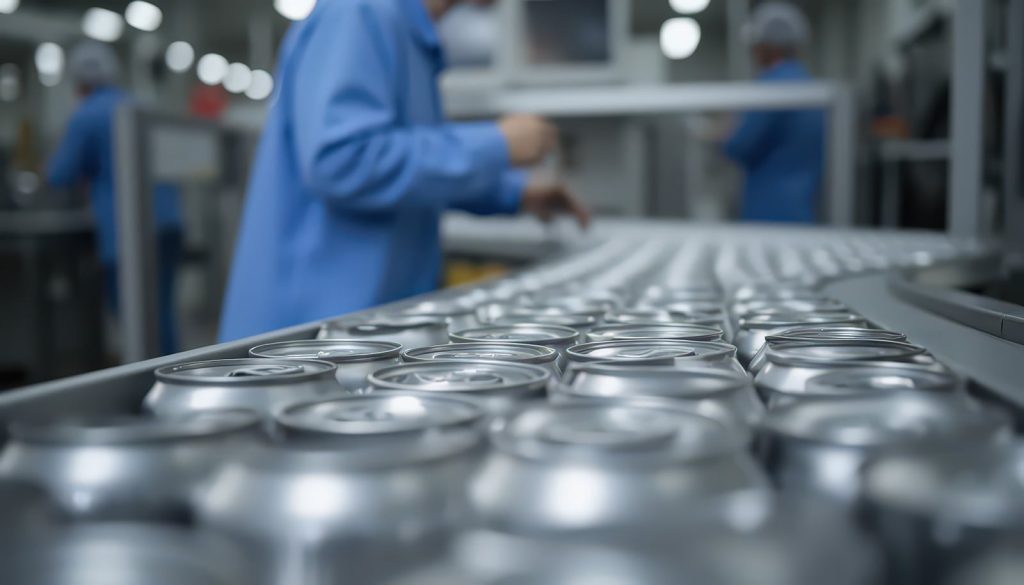
You approved the sample. You loved it. Then it ran at the co-packer and it tasted different. Maybe the carbonation was off, maybe the flavor flattened, maybe the can started corroding on the warehouse floor. You were not approving your product. You were approving a guess.
Direct answer. A beverage formula is only as good as the production line it is built for. Most formulators develop a recipe on the bench using equipment that does not represent how the liquid will actually be manufactured; the brand discovers the gap at scale, when the cost is already sunk. The fix is to bake manufacturing reality (liquid composition, processing method, and end-state container) into the first sample, not the tenth.
Why so many beverage brands taste their first failure at scale
The moment is more common than the industry admits. A founder spends months on bench samples, signs off on the one that tastes the way they imagined, and writes a check to a co-packer. Eight weeks later a truck arrives with the first commercial run, and the liquid is not the same drink. The acidity is sharper, or the mouthfeel is thinner, or the can is leaking at the seams. The founder did not change the recipe. The recipe never accounted for what was about to happen to it.
Most beverage formulators do not work in production-grade conditions. Their lab equipment does not heat the liquid the way a tunnel pasteurizer does. Their preservative system is calibrated to a cold storage shelf, not a 12-month ambient stability window. Their container is whatever bottle was on the shelf, not the can that the co-packer will actually run. Every one of those mismatches is a future surprise.
What does manufacturing viability mean in beverage formulation?
Manufacturing viability is a beverage formula’s ability to be produced at commercial scale without losing the taste, stability, and structural integrity it had on the bench. A formula that scores well on viability behaves the same at five cans and at 500,000. A formula that scores poorly tastes one way as a sample and another way as a finished product.
Viability is not a downstream concern. It is a formulation input. The decisions that determine whether a formula will hold up at scale (the acid system, the preservative load, the heat process, the container) are decisions made before sample one. Treating them as packaging-stage problems is what creates the bench-to-scale gap.
The three-part check: liquid, process, container
From our experience working with 150+ brands, almost every bench-to-scale failure traces back to a mismatch in one of three areas. The job of a formulator who actually builds for production is to validate all three before signing off on the first sample.
First, the liquid composition. The exact acid system, sweetener, electrolyte profile, and functional ingredient set the formula will use at scale. If a brand reformulates the acid system between sample and production (because a cheaper supplier was sourced, or the COGS was over budget), the formula has effectively been changed without being retested. The same applies to preservatives. A formula built with a sorbate-benzoate system tastes different from one built for a clean-label, heat-only stabilization, even if the flavor profile on paper is the same.
Second, the processing method. Hot fill, cold fill, tunnel pasteurization, HTST flash pasteurization, or aseptic. Each one does something different to the liquid. Heat changes flavor compounds. Pressure changes mouthfeel. The bench sample that was poured cold into a glass beaker did not experience any of that. If the production process was not simulated at the bench, the production result will not match the bench. (For more on this, see our guide to hot filling versus cold filling, and our companion piece on tunnel pasteurization.)
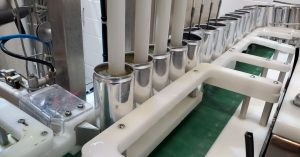
Third, the end-state container. The can, bottle, or pouch the product will actually ship in. Container choice is not a final step. The container reacts with the liquid. High-electrolyte formulas can compromise standard aluminum can liners. High-acid juices can degrade certain coatings. High-ABV cocktails behave differently in tin than in aluminum. We cover this in depth in our companion article on can liners, but the principle holds across all packaging: the container is part of the formula.
Bench-built versus production-built formulation
Most beverage formulators are not equipped, financially or operationally, to simulate a production environment in their lab. A real heat simulation requires the right pasteurization equipment. A real container test requires running candidate containers through full stability cycles. A real preservative trial requires shelf-life studies that take weeks. Most labs cannot afford the time, and most clients do not want to wait for it.
The table below sketches the practical difference between a bench-built formula and a production-built one. The bench-built approach is faster and cheaper at the front end. The production-built approach is faster and cheaper at every stage that comes after.
| Bench-built formula | Production-built formula | |
|---|---|---|
| Heat process in sample development | None; sample is mixed cold. | Sample is heat-treated using the planned production method. |
| Preservative system | Often added later, after flavor is locked. | Designed in at sample one; flavor accounts for it. |
| Container | Glass beaker or generic bottle. | Sampled in the actual end-state container. |
| Shelf stability data | Theoretical or post-hoc. | Validated through accelerated and real-time stability studies. |
| What the founder is approving | A snapshot of a liquid that does not yet exist commercially. | A direct representation of the finished product at scale. |
| When problems surface | At the co-packer, after the contract is signed. | At the bench, before a check is written. |
What it looks like when manufacturing reality is built in from sample one
When a sample is built the same way it will be produced, the founder is tasting all of the production effects at the same time. The heat process, the preservative system, the stability window, the container interaction. A sample becomes a direct representation of what the product will be at commercial scale.
The practical version of this is straightforward. Before any flavor work begins, the team locks the production parameters: which heat process the co-packer will run, which preservative system that allows, which container the brand will ship in. The formula is then built inside that envelope. The acid system, sweetener, and functional ingredients are chosen for how they behave through that specific manufacturing pathway, not for how they taste in a cold beaker.
The payoff is the absence of surprises. The first commercial run tastes like the bench sample. The shelf-life data holds. The cans do not leak. The founder is approving a product, not a guess. Our companion piece on why pilot production matters covers the second half of this story: how a properly designed pilot run confirms what the bench predicted.
Why most labs do not work this way
There are three honest reasons. First, equipment. Most contract formulation labs do not own the pasteurization, filling, and packaging gear required to simulate a production line. They were set up to develop flavors, not to validate manufacturing. Second, expertise. Building for production requires people who have worked on the production side, not only the bench side. That skill set is rarer than the industry’s marketing makes it sound. Third, time. Slowing down on the front end to prevent a fire on the back end means the first sample takes longer to deliver. Some clients read that pace as inefficiency. The clients who have been burned before read it as exactly what they wanted.
This is the cost. A production-built formula takes more time at the start. It saves time, money, and brand reputation at every step that follows.
How MetaBrand approaches manufacturing viability
From our experience formulating across 150+ brands (including Poppi, ZBiotics, Jones Soda, Sanzo, Molson Coors, and Momofuku), we have settled into a working principle: every sample is built the same way it will be produced. The team locks the processing method and the container before flavor work begins. Heat-treated samples come out of the lab heat-treated. Preservative-stabilized samples come out preservative-stabilized. The end-state container is sampled, not assumed.
This is not a faster process. It is a less-surprising one. The bench-to-scale gap is closed at the bench, before a co-packer is selected, before a contract is signed, before a brand has to explain a quality issue to a buyer or a retailer.
If you are early in formulation, or if you are recovering from a co-packer run that did not match a sample, this is the conversation to have with us before anything else.
Frequently asked questions
The most common reason is that the bench sample was not built using the same processing method the co-packer is running. Heat changes flavor compounds. Pressure changes mouthfeel. A preservative system that was added after the flavor was locked tastes different from one that was designed in. If the sample did not go through the same heat process, preservative load, and container the co-packer is using, the production result was always going to drift.
The bench-to-scale gap is the difference between a beverage as it exists in a lab sample and the same beverage as it actually ships out of a production line. The gap shows up as flavor drift, stability failures, container corrosion, or COGS that do not match what the lab projected. It is almost always caused by formulating without accounting for how the liquid will be manufactured.
Before flavor work begins. The processing method (hot fill, cold fill, pasteurization type), the preservative approach, and the end-state container all change how the formula has to be designed. Locking those three before sample one means the formula is built inside a real production envelope rather than being retrofitted to fit one later.
Sometimes, partially. A good co-packer can flag issues, suggest adjustments, and run trials. But a formula that was not designed for the production line is being patched, not solved. The cleaner answer is to design for production from the start. By the time a brand is at the co-packer, the formula’s manufacturability is largely fixed.
Costs vary widely based on volume and where the failure surfaces. Direct formulation rework can run from a few thousand dollars into the tens of thousands for a single attempt. The larger cost is usually elsewhere: a delayed launch, a buyer who passes, a co-packer run that has to be scrapped, or a quality issue that hits social media. Most first-time founders under-budget this category by a material amount.
Three direct ones. First: will the samples I taste be built using the same heat process, preservative system, and container as my production run? Second: what does your stability testing look like, and how long does it take? Third: what happens if the formula does not behave the same at the co-packer as it did in your lab? The answers tell you whether the lab is built for development or for manufacturing reality.
Talk to MetaBrand before you finalize your formula
If you are about to approve a beverage sample, ask one question before you sign off: was this built the way it will be produced? If the answer is no, the formula is a guess. The cleanest way to avoid the bench-to-scale failure is to bring a partner in who treats manufacturing as a formulation input from sample one.
MetaBrand has formulated and manufactured beverages for 150+ brands over more than a decade, from FDA-registered, TTB-approved facilities in Edison, New Jersey. We will tell you what will scale, what will not, and what to fix before a co-packer ever sees the formula.
Schedule a free formula audit at metabrandcorp.com. We will spend the time on the front end so you do not spend it on the back end.
Related reading: Read our companion piece on how acids shape beverage formulation, and our guide to choosing the right can for your formula. Both expand on the three-part check (liquid, process, container) introduced here.